
India–EU Trade Agreement (2026): What India Gains, Key Growth Sectors, and What It Means for Indians in Europe
Why the India–EU deal matters now
The newly concluded India–EU Free Trade Agreement (FTA) is being positioned as a major step in building a modern, rules-based partnership between two large economies. Official summaries indicate the agreement aims to expand market access, reduce tariffs across a wide set of goods, and create a more predictable environment for services and professional mobility.
For Indian exporters, the big headline is access: India’s official factsheet says India gets preferential access across 97% of tariff lines covering 99.5% of trade value in the EU market—especially significant for labour-intensive sectors.
For NRIs/OCIs, this deal is not only about exports—it can reshape jobs, mobility, cross-border business, and investment themes (manufacturing + services + compliance). This is exactly where NRIGrow can help you convert macro changes into personal financial decisions.
11) What does India Government & Indians gain from the deal?
A) Stronger export competitiveness (especially labour-intensive industries)
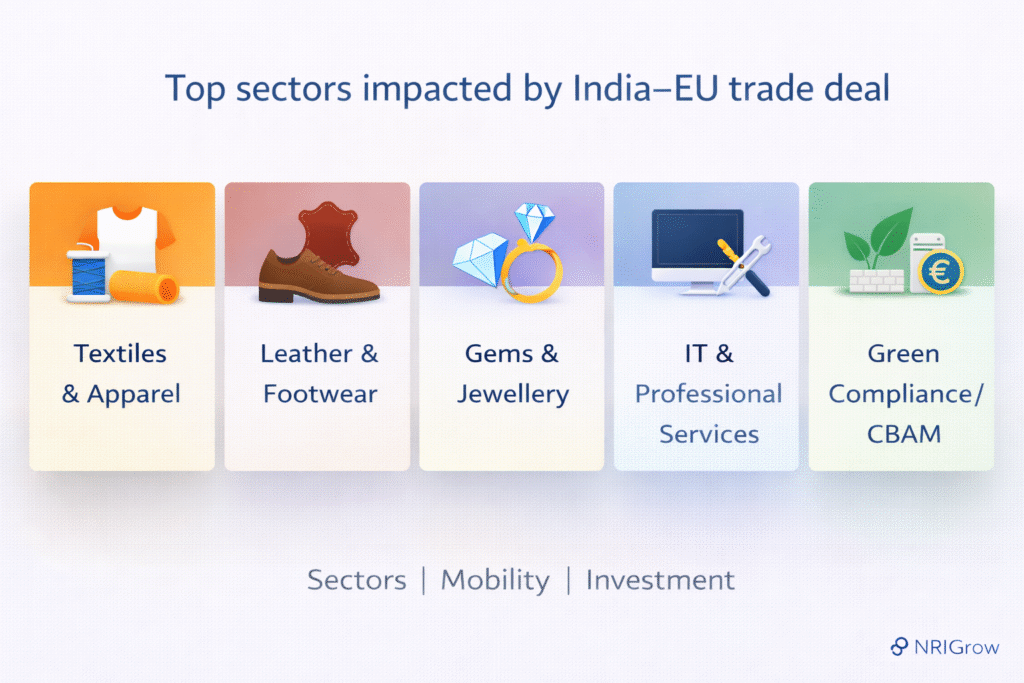
India’s official factsheet highlights immediate duty elimination for a large part of India’s exports, covering key employment-heavy sectors like textiles, leather & footwear, tea/coffee/spices, sports goods, toys, gems & jewellery, and certain marine products.
https://www.commerce.gov.in/wp-content/uploads/2026/01/Factsheet-on-India-EU-trade-deal-27.1.2026.pdf
This matters because:
- Better pricing in EU markets can increase demand for Indian products
- More export orders often translate into more jobs in manufacturing clusters
- MSMEs benefit when market rules become stable and predictable
B) A more predictable environment for services + professionals
The same factsheet notes a structured framework for services sub-sectors like IT/ITeS, professional services, education, and other business services, aiming to create stable conditions for Indian providers in the EU market.
C) Diversification of inputs & higher-quality imports
India’s offer to the EU includes phased reductions, and the factsheet suggests EU high-tech imports can diversify India’s sourcing and reduce input costs, which can support Indian production competitiveness.
2) Which sectors can India develop faster because of this deal?
Based on the official sector emphasis and the way trade agreements typically work, India’s
development impact is likely strongest where exports + value chains + services intersect:
(1) Manufacturing & export clusters
- Textiles and apparel
- Leather and footwear
- Gems & jewellery
- Marine/seafood.exports
These are directly called out as key labour-intensive sectors that gain competitiveness via tariff changes.
(2) Engineering goods + industrial upgrading
The factsheet points to opportunities in engineering goods and broader value chain integration as tariffs and compliance friction reduce.
(3) Services-led growth (IT, professional services, education)
India’s services strength can expand via clearer entry rules and more stable market access frameworks mentioned in the factsheet.
(4) Compliance-driven “green transition” readiness
A crucial reality check: Europe’s climate-linked compliance is tightening. The EU’s Carbon Border Adjustment Mechanism (CBAM) became fully operational from 1 Jan 2026.
This pushes Indian exporters (especially carbon-intensive sectors) to improve carbon accounting, cleaner processes, and documentation—creating a strong incentive for industrial modernization.
https://taxation-customs.ec.europa.eu/carbon-border-adjustment-mechanism_en?utm_source
3) What benefits can Indians living in Europe get?
If you’re an Indian professional, student, business owner, or family in Europe, the deal can help in 3
ways:
A) Better mobility/temporary entry clarity for professionals
India’s official factsheet mentions an assured regime for temporary entry and stay for categories such as Business Visitors, Intra-Corporate Transferees, Contractual Service Suppliers, and Independent Professionals.
It also states that independent professionals get certainty in 17 sub-sectors (including IT, R&D, higher education), and there’s a framework to enable Social Security Agreements in 5 years with EU member states.
B) More cross-border opportunities for EU-based Indians (business + career)
As tariffs and regulatory frameworks become smoother, EU companies may expand vendor networks and partnerships with Indian suppliers, which can create:
- More hiring in India-facing roles
- More contract work and consulting pipelines
- More opportunities for diaspora entrepreneurs connecting EU demand to Indian supply
C) Investment themes for NRIs/OCIs: new winners & new risks
Many NRIs/OCIs invest based on “what India will build next.” Trade integration can strengthen long-term themes like:
https://www.reuters.com/world/india/europes-carbon-tax-tariff-quotas-hinder-indias-steel-exports-steel-secy-says-2026-02-09/?utm_source
- Export-led manufacturing
- Services exports
- Quality/compliance upgrades for global markets
But there’s also risk: for example, Indian steel exports are being impacted by CBAM and related EU measures, and India has discussed supporting affected exporters.
NRIGrow angle: If your income is in Europe and investments are in India, you need a portfolio that can capture these themes without over-concentrating in one sector.
4) Where can Europe invest in India (and why)?
The deal is one pillar; the broader India–EU strategic agenda emphasizes sustainability, technology,
innovation, and connectivity.
Europe’s investment interest in India typically strengthens in areas where EU has global strengths +
India has scale: https://ec.europa.eu/commission/presscorner
A) Clean energy & sustainability
- Renewables supply chains
- Green tech standards + industrial decarbonization
- Climate compliance tools (measurement, reporting)
B) Technology & digital systems
India–EU collaboration has been discussed through the Trade and Technology Council, including focus areas like digital governance, tech standards, and strategic technology domains.
https://www.mea.gov.in/bilateral-documents.htm?dtl%2F39113%2FJoint+Statement+Second+Meeting+of+the+IndiaEU+Trade+and+Technology+Council+New+Delhi+February+28+2025=&utm_source
C) High-value manufacturing partnerships
The agreement’s direction—tariffs + predictable rules—can encourage EU firms to:
- Expand sourcing from India
- Set up capability centers
- Invest in manufacturing linkages (auto components, pharma supply chain, industrial tech)
Also, some reporting indicates European firms are exploring deeper market presence in India as the trade agreement progresses (including capital market interest)..
https://economictimes.indiatimes.com/markets/ipos/fpos/freedom-to-act-europe-inc-pushes-plans-to-list-in-india/articleshow/128181800.cms?utm_source &from=mdr
5) What benefits can Indian companies get from this deal?
1) Lower tariff barriers = better margins + higher volumes
For export-heavy industries, duty reductions can improve price competitiveness, making it easier to win EU buyers at scale. Official numbers suggest major coverage across tariff lines and trade value.
2) More stable rules = easier long-term planning
Trade agreements reduce uncertainty around duties and market access. India’s factsheet explicitly frames the deal as enabling long-term planning and value-chain integration, including for MSMEs.
3) Services exports + talent mobility support
Indian IT, consulting, education, and professional services firms can benefit from clearer access and mobility channels referenced in the official summary.
4) Pressure to upgrade compliance (which becomes a competitive moat)
EU compliance expectations (especially carbon-related) will increasingly reward companies that can prove lower embedded emissions and strong documentation. With CBAM operational from 2026, exporters who upgrade early can gain an edge.
https://taxation-customs.ec.europa.eu/carbon-border-adjustment-mechanism_en?utm_source
What should NRIs/OCIs do next?
If you live in Europe and invest in India, consider a simple 3-step approach:
- Map your India exposure (equity, mutual funds, property, business)
- Identify winners & risks: export-led sectors may grow, but compliance-heavy sectors may face short-term pressure (e.g., carbon-linked costs)
- Plan your structure: NRE/NRO, repatriation, tax residency, documentation—so your returns are efficient and compliant.
This is where NRIGrow can support: from clarifying investment routes to building a long-term India
strategy aligned with global changes.
FAQs
Q1. Is this deal only about goods and tariffs?
No—official summaries highlight services frameworks and professional mobility categories too.
Q2. Will Indians in Europe get direct benefits?
Directly, the deal mentions mobility categories and services certainty. Indirectly, stronger India–EU
business integration can create more cross-border career and business opportunities.
Q3. What’s one big challenge companies must prepare for?
Climate-linked trade compliance, especially CBAM, which is operational from 1 Jan 2026.